
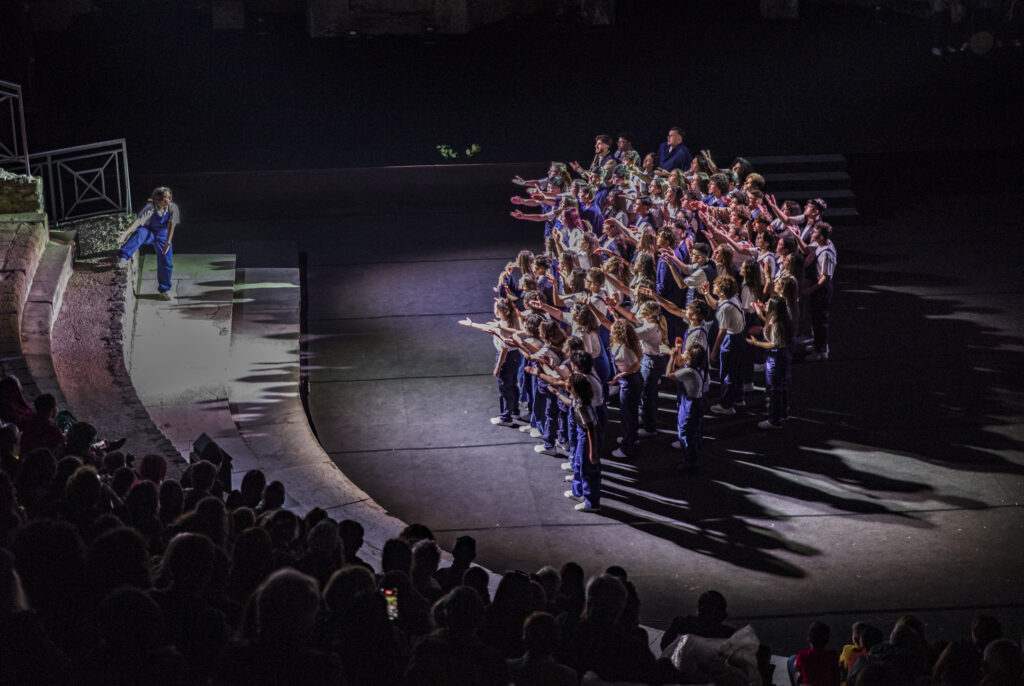
About a year ago, I was blessed to be among the audience of Aristophanes’ Lysistrata, performed by young people at the ancient theatre of Pompeii as part of the SOGNO DI VOLARE project, directed by Gabriel Zuchtriegel—director of the Archaeological Park—and Maria Rispoli, in collaboration with the Ravenna Festival. It was a life-changing experience, one that I will carry with tenderness and recall every time I want to remember why I love theatre. The Aristophanic work came to life through Marco Martinelli’s non-scuola system, connecting past, present, and future on multiple levels. It was a performance fully embedded in the present, but also a bridge between worlds trying to reconnect and remind us how much better we are when we are “together”. A vibrant and artistically engaging performance, it was “rewritten” in the present tense of these young people. Deeply political, it featured songs from Southern Italy in place of the choral odes, sung by the young performers. The curtain call included the audience, which filled the orchestra, turning actors and spectators into one. It then turned into a celebration of Napoli’s football victory the night before. In short, it was a theatre directly connected to life, uniting past and future, and giving life again to “archaeological” spaces condemned by time to be mere exhibits rather than living places. This is the theatre of Marco Martinelli – a combination of art, political engagement, and pedagogy. A mirror reflecting the concerns and issues of the present at a collective level; an ongoing dialogue with his spiritual predecessors – from Aristophanes to Giordano Bruno and Artaud – and a dialogue between the gods of yesterday (Dionysus) and today (his theatre’s headquarters in Ravenna is housed in a 14th-century church!).
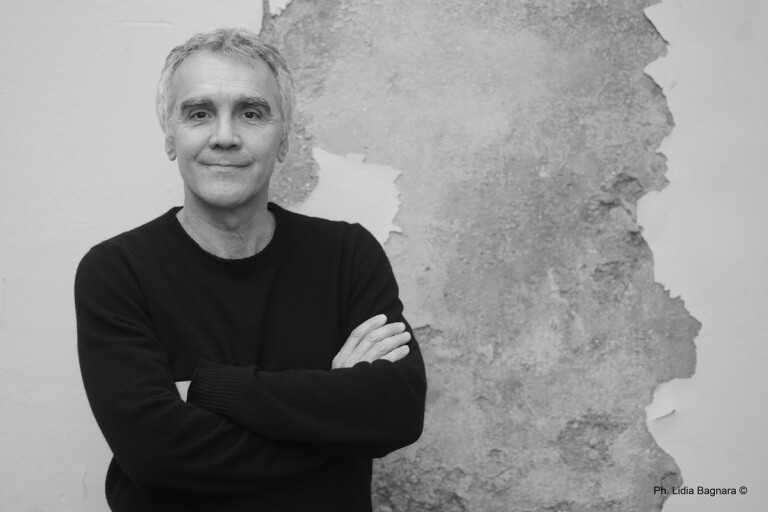
Martinelli is one of the most important contemporary directors and playwrights in Italy. In 1983, together with his partner in life and art Ermanna Montanari he founded the Teatro delle Albe in Ravenna. He has never treated theatre as a mere performance, but as an “anatomical study” of human existence and as a collective process and experience involving the community.His work has travelled from Italy to Europe and from Chicago and New York, all the way to the slums of Nairobi and Senegal.
I had the pleasure to meet him and have a powerful discussion about his work, his systema and the way he sees Theatre.

Your work expresses a kind of “theatre of the many,” a theatre that emerges from the community and the chorus rather than from star performances. How do you define the chorus as a political and poetic force in contemporary theatre?
It is the secret of theatre. In 5th-century Athens as in the time we are living in. In short: if there is no chorus, there is no theatre. The chorus is the turbulent presence of Dionysus, the god who confuses, mixes, intertwines the I and the collective, making them dance together. Theatre is “political” because it concerns the “polis,” the city where I stand, and at the same time the whole planet, where we are always virtually connected. Theatre is “political” when it speaks the language of poetry, when it illuminates the infinite desires of the soul.

You have often spoken about theatre as an encounter, an exchange between the actor, the audience, and the world they share. How does this idea influence your choices as a director and playwright?
It always affects me: first of all, I am a citizen! I inhabit this world and its ugliness, just like the spectators who come to see my work. And I do not like this world—it is too violent and hypocritical. It pretends to be “rational,” yet it constantly creates wars and devastation, pollution and misery. My theatre is a rebellion against the world. An invocation of beauty.
Throughout your career you have revisited classical texts many times, from Aristophanes to Dante. In your opinion, what is the fundamental message that classical theatre still offers us today, in the 21st century?
That we are the same as we were then. That we must carry out a “self-examination” every day. That so-called “progress” concerns only technology, which in some cases, yes, makes life more comfortable (for some, not for all), while in others allows us to slaughter each other more quickly. For the rest, nothing new under the sun. But—and this “but” is fundamental—the classics themselves also tell of our irrepressible desire for justice: Lysistrata, Dante’s Beatrice, Antigone—these are our rebellious saints, disturbing ghosts who interpret our present.
You balance original writing with radical rewritings of the “classics”: what guides you in deciding when a classic needs to be transformed rather than preserved?
I always start from a classic that I love, one I identify with: Aristophanes, not Menander; neither Molière, not Marivaux. And because I love him, I feel entitled to create a “staging” that is also a “bringing to life.” Rewriting it, transforming it, is the most effective way to preserve it. I have seen too many comedies by Aristophanes ruined by the ideology of “respect for the text.” Aristophanes wrote his first anti-war play at the age of 18, an enraged teenager: it is he himself who begs us to cross through his marvelous tales by reinventing them in the present. If we think of the chain of playwrights across the centuries: Plautus rewrites Menander, Molière rewrites Plautus, Brecht rewrites Molière and Shakespeare—so I may allow myself to rewrite Brecht by returning to Aristophanes. A fine band of thieves, or if you prefer, vampires—people who feed on the blood of the dead.

How did you begin your work with the idea of the non-scuola? What was missing in traditional theatre education that the non-scuola tried to answer?
We always come back to the same point: what was missing was Dionysus, the “little word borrowed from the Greeks,” as the young Nietzsche writes. Dionysus is the buried god, who must be unearthed every day. What was missing was the awareness that education is a rejoicing of the soul—it is the joy of learning, the wonder of knowledge. Away from the Smartphones: the first step of the non-scuola is to look at each other—you and I, my eyes into yours: are we lit by desire? The first step is desire, the intoxication of being on stage together, on those poor wooden boards: that is where it begins. Shouting, singing, hopping—the emergence of body-voice-soul: these are the next steps. Keeping body-voice-soul at the center is the revolutionary task, the scandalous heresy of this age, subjected to the dictatorship of screen-prisons: a dictatorship suffered above all by the very young, infected by devices that pin down their bodies and their imagination.
How easy is it to communicate with younger generations? What have you learned about theatre from the young participants themselves?
I learn every day. For the past 35 years. I learn to burn through existence. I learn to grow old. I learn to be moved, watching the buds sprouting on branches.
Is Teatro delle Albe your home?
I married Ermanna on September 3, 1977; three days later we were on stage with Waiting for Godot by Samuel Beckett. We founded the Albe in 1983. I have a habit of endurance.

You have collaborated with artists, communities, and students from Dakar to New York. How does this global engagement influence your idea of theatre as a shared human practice, beyond specific cultural traditions?
We are all the same humanity, all made of the same wood. Then, yes, of course, there are enormous differences—many cultural, linguistic, social variations: I would be blind not to consider them. It is one thing to live in a slum in Nairobi, another in an affluent neighborhood of Milan. But at the level of depth that theatre can reach, pain and happiness sing the same hymn.
You staged Lysistrata in the Ancient Theatre of Pompeii. How does performing in archaeological and non-conventional spaces alter your creative process? Does the place become a co-author of the work?
The place is always a co-author of the work. First of all, one measures oneself against space: even in dreams, space comes first, as psychoanalysts teach us. Confronting the millennia-old stones of the Great Theatre of Pompeii is a powerful emotion: the seating and the stage are immersed in nature, the sky and the surrounding mountains tell us that we are part of the same cosmos. The space of the ancient theatre is a perfect device, where spectators are immersed both visually and acoustically: today’s architects should listen to its lesson more often.

If you had to imagine the theatre of the future, what would you hope it to be like?
What I hope it does not become: a theatre of machines and artificial stupidity. Of algorithms. Let it remain the place where we take each other by the hand and question the mystery: what on earth are we doing here, under this sky? Let it remain enigma and prayer, and a cry against injustice.
Do you have a favorite work?
Among my own, you mean? No. I love them all—they are all my children. Even the flawed ones, the limping ones, even the failures. Above all and mainly the failures, which in the end are the greatest teachers.
Would you tell us a significant episode from your theatrical life?
There would be many… but since you ask for one, I’ll play along. It was 1997. We had just staged my rewriting of a scenario by Carlo Goldoni, The Twenty-Two Misfortunes of Harlequin. Playing Harlequin was one of our actors, Mor Awa Niang, with the strength and stage presence of a Senegalese “griot,” that is, a dancer-comedian-storyteller: hence the transformation of the title into The Twenty-Two Misfortunes of Mor Harlequin. We were invited by the Piccolo Teatro in Milan, the most important theatre institution in Italy: the emotion was great, also because its founding director, Giorgio Strehler, had been a great master, and his Harlequin, Servant of Two Masters is the banner of Italian theatre worldwide. Our presence in the Piccolo’s season immediately sparked major controversy: it was “scandalous,” said the usual reactionaries, “for an African to play a mask of Italian tradition.” But I believe that with this choice I respected the tradition even more: Harlequin in the 16th century was an immigrant who came from the valleys of Bergamo to wealthy Venice, hungry and “foreign,” just like Mor Harlequin, his heir centuries later, who arrives equally hungry and “foreign” from the African savannah to wealthy Europe. On opening night the theatre was packed: there was a sense of celebration, and Strehler sent me a note in the dressing room—which I still keep close to my heart—expressing his delight at the “happy intuition” of a Harlequin for our times. After the first act, which had gone wonderfully, with much laughter and applause during the performance, the police interrupted the show: a phone call had come in—someone had allegedly placed a bomb in the theatre. They did not know if it was true, but they could not take the risk, so they had to check: the police evacuated everyone from the building. We found ourselves in the square in front of the Piccolo; no one wanted to leave. Then our actors began to beat drums and sing: despite the cold Milanese December, the bomb threat did not ruin the “celebration,” it only moved it into the street. After about forty-five minutes, once the checks were completed, we were allowed back in, and we were able to finish the performance. Endless applause followed; we moved into the auditorium to dance and sing with all those who had stayed. When I think back on it, a phrase by Martin Luther King comes to mind, one that has accompanied me since adolescence: “Plant the apple tree, even if you know that tomorrow the bombs will explode.”